

Central City science fair returns for twentieth year
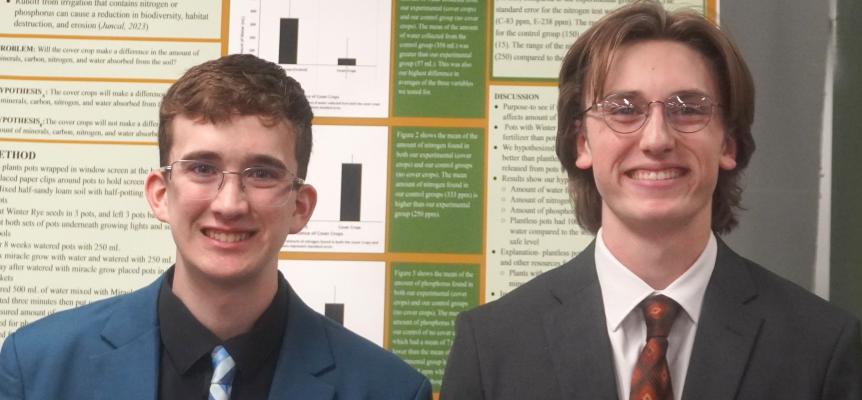
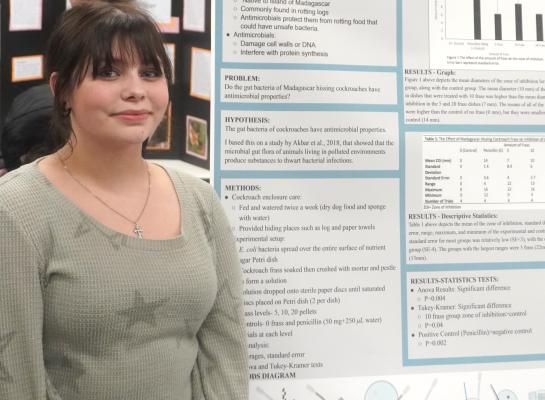
Another year and another successful Central City Public School’s Science Fair is in the books. This was a big year for the program that has been a cornerstone at the school for decades. Among those smiling faces presenting were the likes of Dylan Church and Fyn Fasbender who worked together on their research project. Other bright minds like Kaelyn Kelly (bottom photo) worked independently as they researched topics that impact the world around us.
On March 4, the numerous young researchers of Central City High School had the opportunity to present their projects after months of hard work. The researchers set up in the high school’s commons, where they would elaborate upon their research to judges, along with interested peers and parents alike. This marks the twentieth year of the science fair with Chelle Gillan at the helm. Chelle is the main coordinator of the event, but still receives plenty of help from the other science teachers there at the school. If the wind didn’t blow the fair-goers away beforehand, this year’s research certainly would. Despite the harrowing wind which caused multiple businesses in town to close that day, the science fair was still on, showing nothing can impede the ways of science.
Amongst the prestigious young researchers was one Parker Santin, who chose to research the presence of lead paint across local houses. The state of Nebraska has the highest blood-lead levels in the United States, and is one of the main reasons he chose to study this issue. Parker tested 30 local houses across Merrick and Hamilton counties for lead via swabbing around various surfaces both inside and outside, such as windowsills. 15 of the houses he tested were built before 1978, and the other 15 were built after. 57% of the houses he tested were positive for lead. This is an important and rather alarming statistic, and lead-presence in the home can lead to disaster. Having even the smallest amount of lead in one’s blood can lead to nervous system issues, which can affect people for the rest of their lives. Parker encourages people to remediate their homes along with getting tested for lead to avoid potential calamity if harmful quantities of the metal are found.
Parker’s father, Ryan Santin, was present at the event as well as a judge. Ryan expressed how proud he is of his son for taking an investigational approach to his research, saying “I’m happy it aligns with his future goals.”
Kaelyn Kelly’s research was absolutely “hissing” with personality, literally! Her project revolved around testing the frass (droppings) and stomach contents of Madagascar hissing cockroaches for antimicrobials, which could be a potential source of new antibiotic development. Kaelyn chose to research this topic due to infections being on the rise, along with potentially finding new sources to develop antibiotics. Her experiment proved conclusive, and showed positive results. She found the solution from the cockroach guts did indeed hinder bacterial growth. Kaelyn plans for a second round of research on this topic next year to test different types of bacteria, along with general innovation and improvement of the project.
Dylan Church and Fyn Fasbender were one of the two partner projects at the fair. They teamed up to test the effect of cover crops on runoff water from fields. Cover crops are designed to hold soil into the ground to avoid erosion and prevent harmful runoff, which is when heavy amounts of rain move soil, minerals, and potentially harmful chemicals from fields elsewhere. The excess runoff can cause algal blooms, which can contaminate water and even harm wildlife.
The two boys both landed on this idea due to their love of the outdoors and outdoor activities, such as fishing. They both noticed the negative effects the runoff water had on the environment, and wanted to help their home state in any way they could. The pair studied the effects of fertilizer runoff via testing strips. They found that having cover crops were a direct upgrade over a lack of them, and are hoping to continue their testing on an actual field next year.
Every high school researcher is one of Chelle’s students, and she’s involved from the beginning of every project to its end. She helps her students think of ideas, order supplies, and is generally with them for every step of the way. In the future, she plans on possibly having the science fair take place during the day, with a fundraiser meal being another possibility. The idea of having a science fair was originally started by Judy Williams, a prior teacher at Central City and Chelle’s inspiration, mentor, and “reason I do research”, as she put it.
Seeing her students present their finding after multiple arduous months is easily one of the best feelings in the world for Chelle, with her saying “Seeing the students present their research at the science fair is amazing! They gain a great deal of confidence compared to the beginning of the process. They are very passionate about what they have done, and rightly so. Doing scientific research is never easy, but seeing all that the students learn through the process is very rewarding.”
With every new generation, comes a new generation of scientific minds. Scientific minds that may one day change the world for the better with their findings. Chelle Gillan shares the same sentiment, stating “The goal of most research is to solve a problem, so as these young people participate in scientific inquiry, they are developing critical thinking and problem-solving skills that will allow them to help solve the difficult problems we face as a society.”